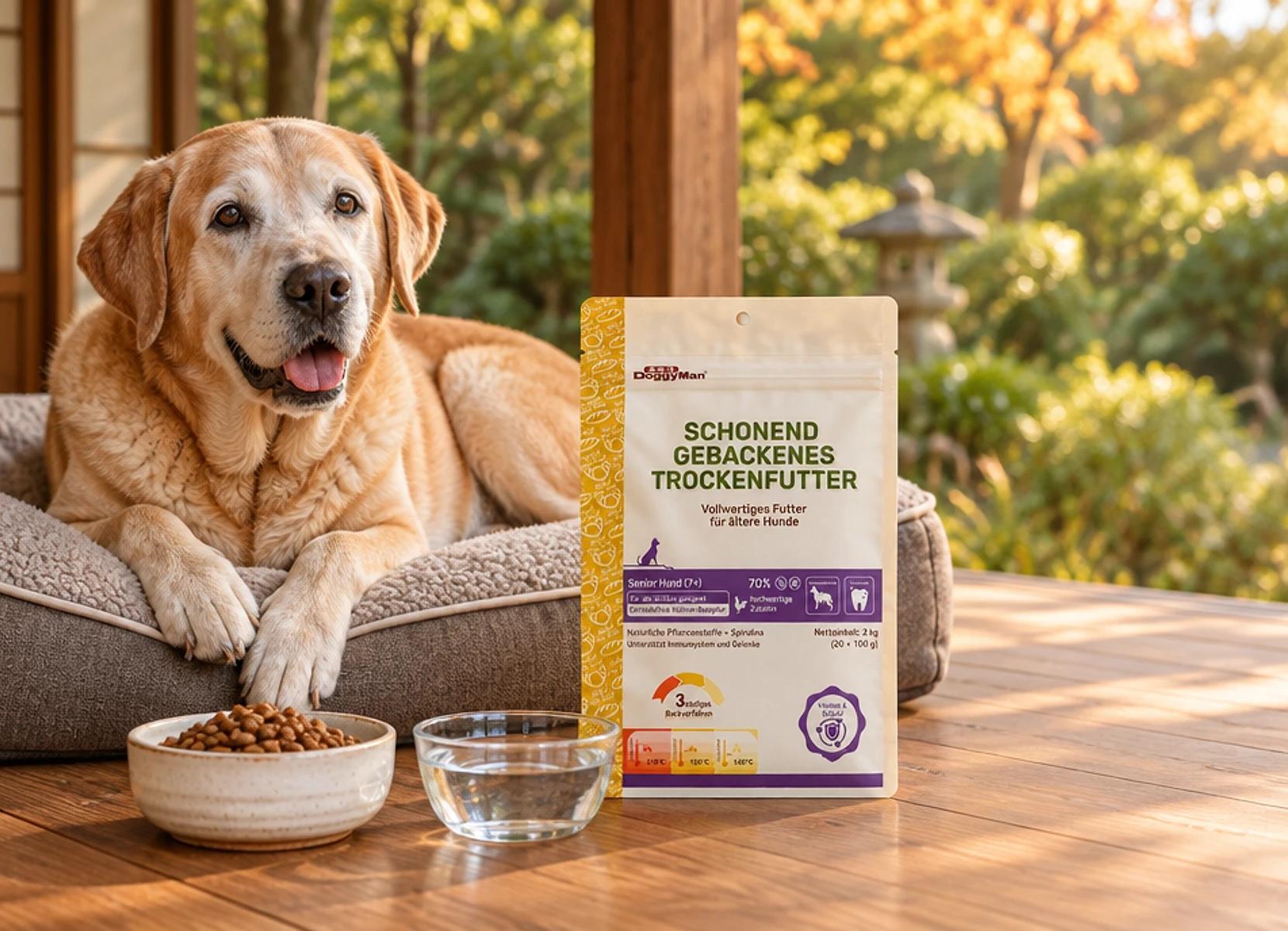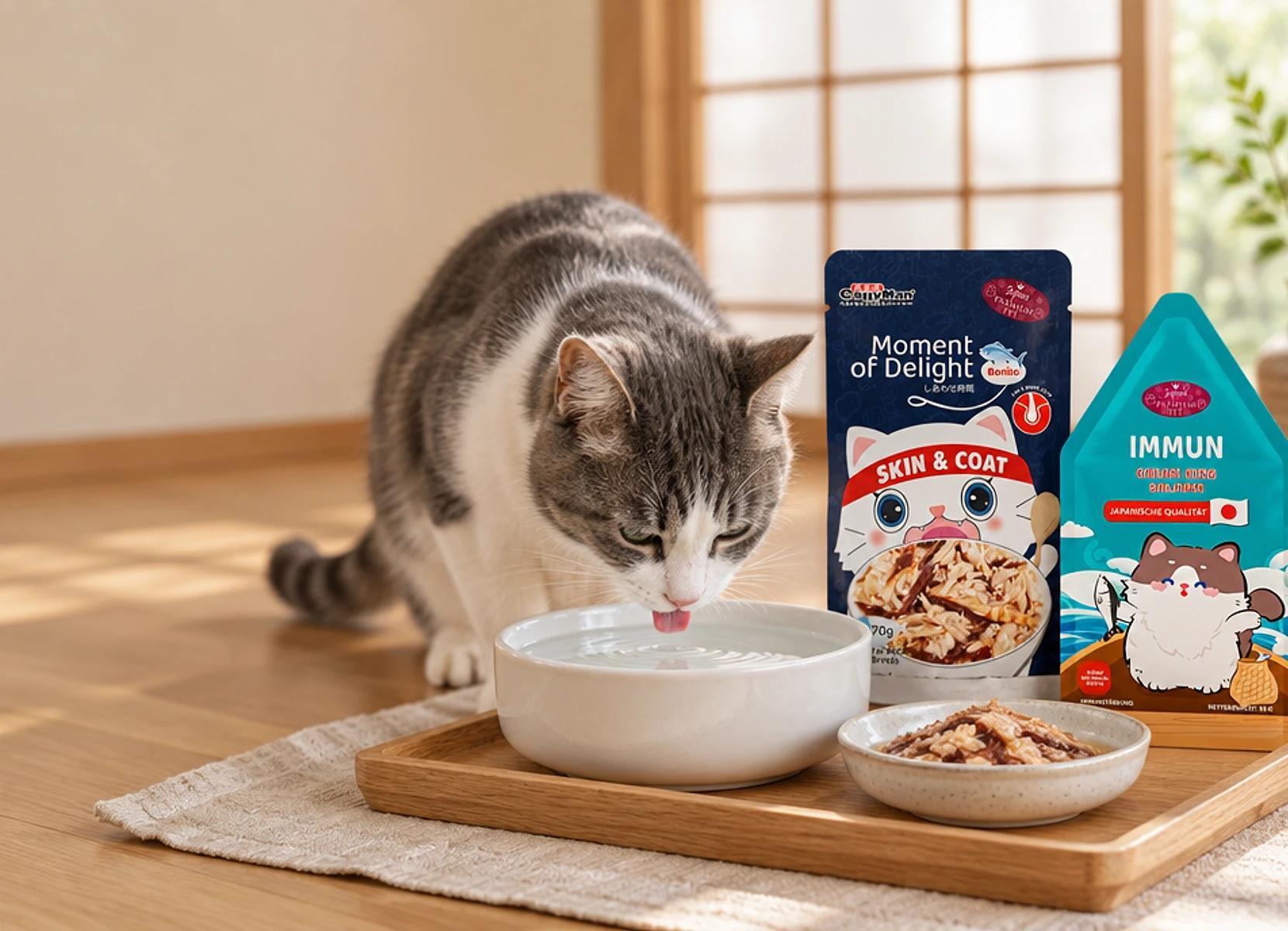
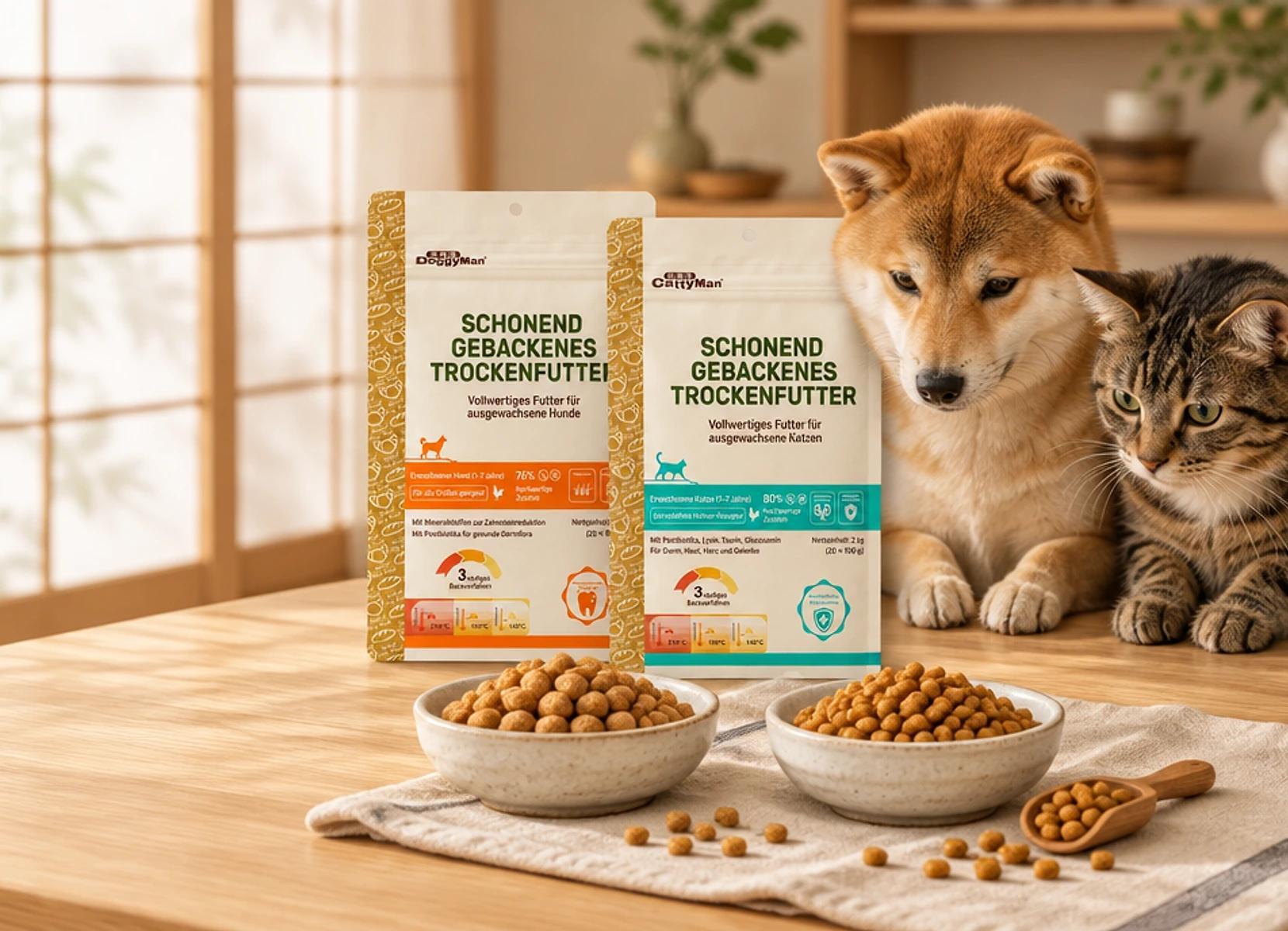
Two ways to cook dry food
Almost all dry food for dogs and cats is cooked, but not in the same way. Most kibble is extruded: a moist, steam-conditioned mix is cooked under heat, pressure and mechanical shear in an extruder, puffs up as it leaves the die and is then dried and coated with fat. Baked dry food starts as a dough that is shaped and cooked in an oven, much like a biscuit, often in several temperature stages. Both methods produce safe, shelf-stable food. The process influences texture, colour, aroma and how thoroughly the starch is cooked, but it does not on its own decide whether a food is good. What matters most is a complete, balanced recipe from a manufacturer with real nutritional expertise and quality control, and how well your animal does on it.
Extruded and baked dry food compared
| Feature | Extruded kibble | Baked kibble |
|---|---|---|
| How it is made | Steam-conditioned mix cooked under heat, pressure and shear, expanded, dried and coated | Dough shaped and cooked in an oven, often in several temperature stages, then cooled |
| Typical texture | Porous, crisp, hard and uniform | Denser and more biscuit-like, usually lighter in colour |
| Starch cooking | Very high | Intermediate |
| Digestibility in a 2024 study with the same recipe | Highest of the methods tested | Slightly lower, still acceptable |
| Sensory profile in a 2014 study | More cohesive, harder and crisper | Lighter colour, fewer fishy off-notes |
| Availability | The vast majority of dry food | A smaller niche |
What happens in the extruder and in the oven
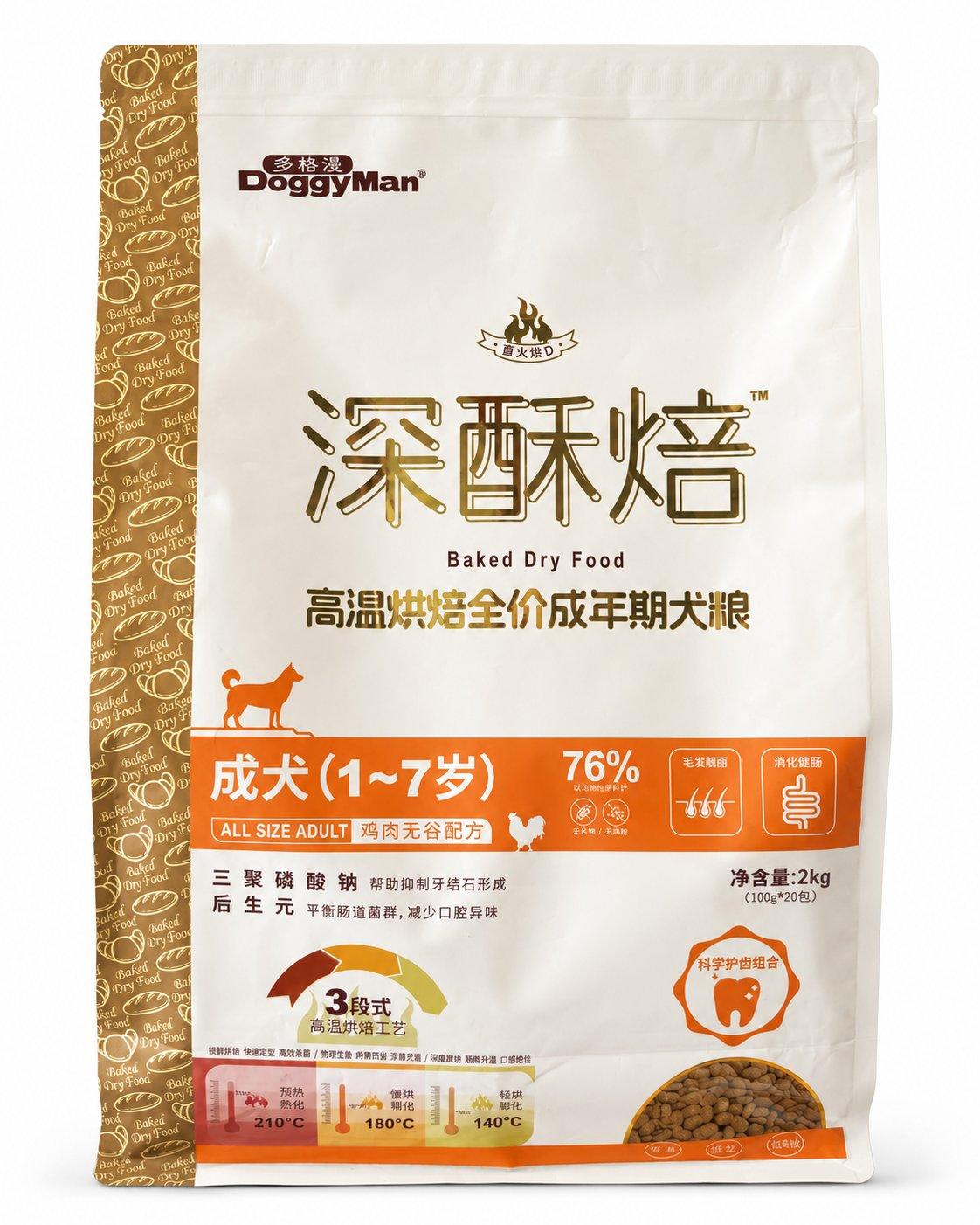
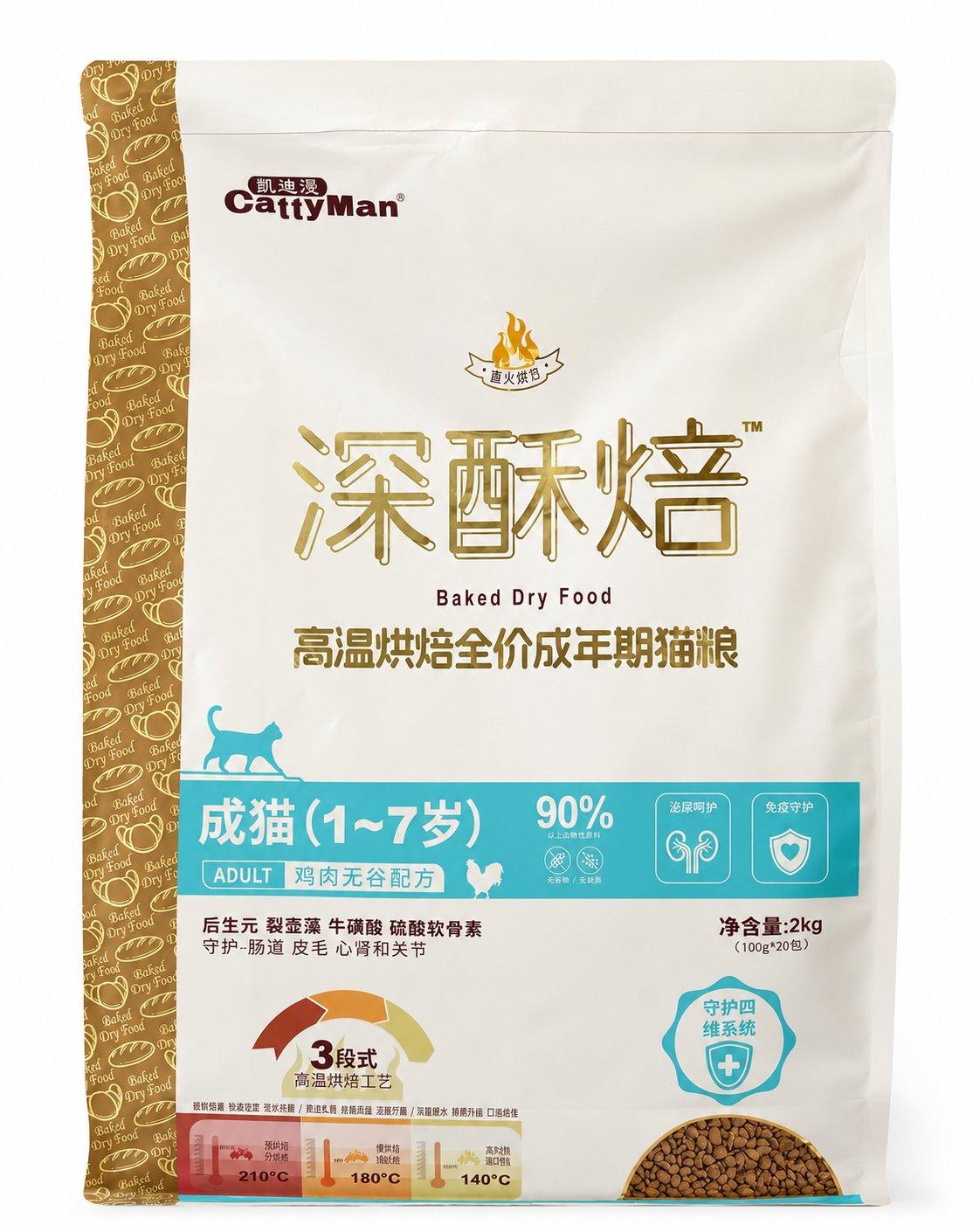
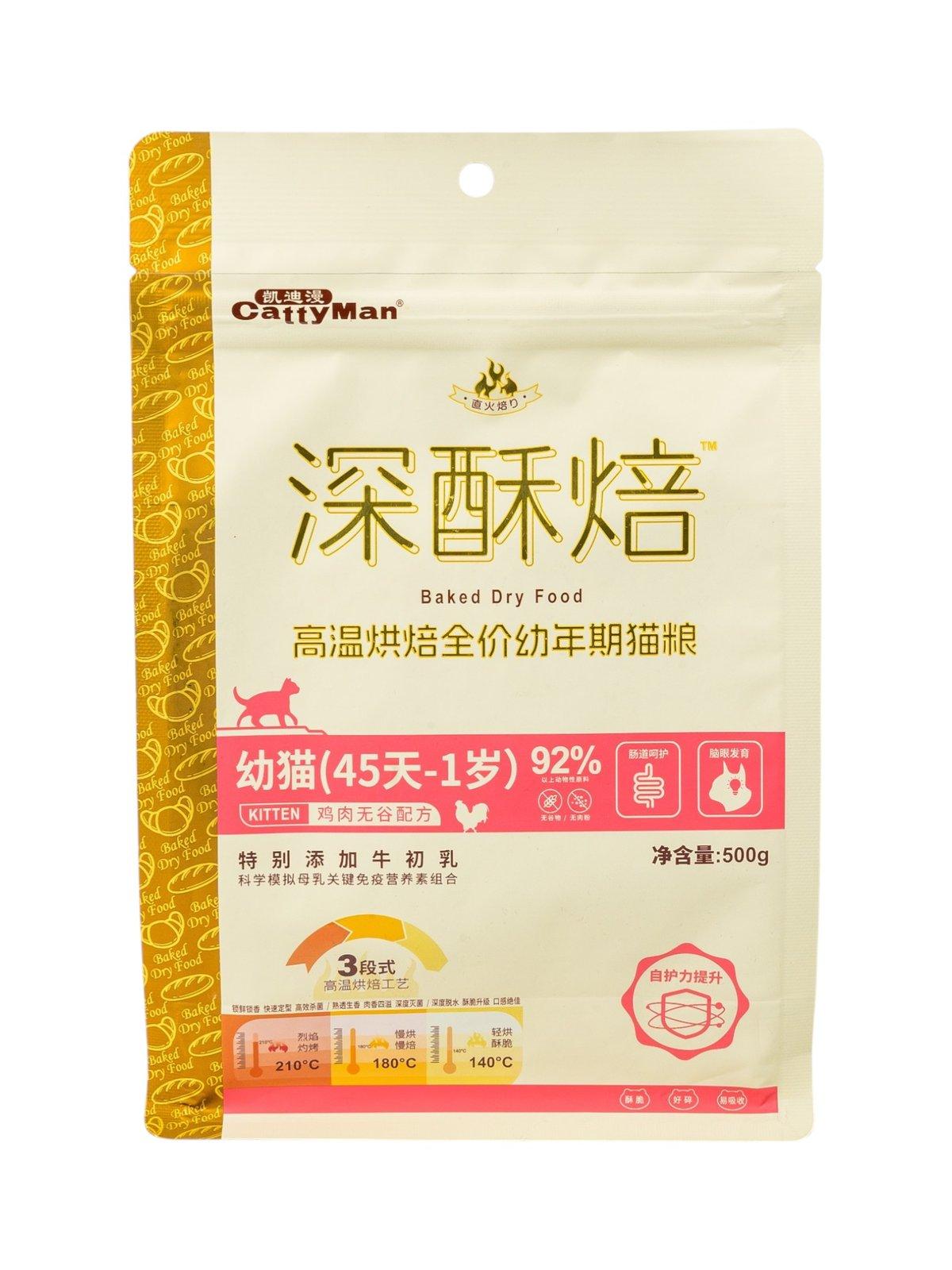
In extrusion, ground ingredients are mixed with water and steam, cooked inside a heated barrel under high pressure and shear, and pressed through a die. When the pressure drops, the moisture flashes off and the kibble expands, which gives it its airy, crunchy texture. The heat gelatinises the starch so that it can be digested and denatures proteins. Baking works without pressure and shear. A dough of meat, other ingredients and water is shaped and baked in an oven. Baked does not automatically mean low temperature: in one research setup the kibble was baked at 220 °C for 11 minutes, and the bags of our baked range describe three baking stages at 210, 180 and 140 °C. The difference lies in how the heat is applied, not in whether the food is cooked.
Oven-baked complete dry food for adult dogs
What research shows so far
Studies that compare both methods with the same recipe are rare. In a 2024 study in the Journal of Animal Science, one corn-based dog food was produced by pelleting, baking and extrusion and fed to 12 dogs. The extruded version had the most thoroughly cooked starch, the highest overall digestibility and the best stool quality; the baked version was in between, and all versions were acceptable. A 2014 sensory study found that baked kibble was lighter in colour and showed fewer fishy, rancid-type notes, while extruded kibble was harder, crisper and more cohesive. Manufacturers of baked food often emphasise aroma and a gentler bite, and many dogs and cats do like the texture. Whether a particular baked food has other advantages depends on its recipe, so judge each product on its own data and on how your animal does on it.
Oven-baked complete dry food for adult cats
How to choose and switch
International veterinary guidelines advise choosing a dry food by what is behind it rather than by marketing words such as premium or holistic. Check that the label declares a complete food for the right life stage, that the manufacturer employs a qualified nutritionist and that quality control is in place. Compare the energy content per 100 grams, because baked and extruded kibble can differ in density: a cup of one may weigh noticeably more than a cup of the other, so weigh portions when you change products. Kibble size and hardness should suit your animal’s mouth and teeth. Switch over about a week by mixing increasing amounts of the new food into the old one. Store dry food in its bag inside an airtight container, away from heat and light, because exposure to air and warmth makes the fats go rancid.
Oven-baked complete dry food for kittens
Baked does not mean raw, cold-pressed or grain-free
Checklist for comparing dry foods
- Look for the words complete food and the right life stage on the label.
- Check whether the manufacturer names a qualified nutritionist and describes its quality control.
- Compare the energy content per 100 grams.
- Weigh portions with a kitchen scale instead of using a cup, especially after changing products.
- Check that kibble size and texture suit your animal’s mouth and teeth.
- Switch gradually over about a week.
- Store the food in its bag inside an airtight container, away from heat and light.
- Judge the result after four to six weeks: body condition, stool quality, coat and appetite.
Frequently asked questions
Is baked dry food healthier than extruded food?
Not automatically. Both methods produce safe, cooked food. In the few direct comparisons, extruded food was slightly more digestible, while baked food had a different texture and aroma. The recipe, the manufacturer’s expertise and how your animal does on the food matter more than the method.
Is baked food the same as cold-pressed food?
No. Baked food is cooked in an oven, often at high temperatures. Cold-pressed food is made with a different process at lower temperatures.
Can I mix baked and extruded kibble?
Yes, if both are complete foods. Divide the daily ration between them according to their energy content so that your animal does not get too many calories.
Does crunchy kibble clean the teeth?
Only to a limited extent. Most kibble breaks before it can scrub the teeth. Daily tooth brushing remains the most effective home dental care for dogs and cats.
How do I know the new food suits my dog or cat?
After four to six weeks, your animal should keep a healthy body condition, have well-formed stools, a shiny coat and a good appetite. If not, talk to your vet before switching again.
Sources
- Journal of Animal Science (2024) — Processing of corn-based dog foods through pelleting, baking and extrusion and their effect on apparent total tract digestibility and colonic health of adult dogs — https://pmc.ncbi.nlm.nih.gov/articles/PMC11005766/
- Koppel et al., Animals (2014) — The effects of cooking process and meat inclusion on pet food flavor and texture characteristics — https://pmc.ncbi.nlm.nih.gov/articles/PMC4494385/
- World Small Animal Veterinary Association — Guidelines on selecting pet foods — https://wsava.org/wp-content/uploads/2021/04/Selecting-a-pet-food-for-your-pet-updated-2021_WSAVA-Global-Nutrition-Toolkit.pdf
- Cornell Feline Health Center — Feeding your cat — https://www.vet.cornell.edu/departments-centers-and-institutes/cornell-feline-health-center/health-information/feline-health-topics/feeding-your-cat
- Japan Premium Pet dog nutrition range — https://japanpremium.eu/de/categories/dog-nutrition
Explore the nutrition range
Compare the Japan Premium Pet foods and treats selected for this guide.
View products